 geo.be Metadata Catalog
2026
Type of resources
Available actions
Topics
INSPIRE themes
federalThemes
Keywords
Contact for the resource
Provided by
Years
Formats
Representation types
Update frequencies
status
Service types
Scale
Resolution
-
UNDER EMBARGO - This dataset is part of BE/2023 sampling campagn in SW Greenland fjords (Igaliku and Tunulliarfik). Pelagic community was analysed using Imaging Flow Cytometry (iFCM) with an ImageStream®X Mk II. Cells were grouped into functional size classes—pico-, nano- and microplankton—according to measured cell length. Cells lacking chlorophyll autofluorescence were classified as heterotrophic or chemotrophic organisms, including heterotrophic picoplankton/bacteria (HP; ≤2 µm) and heterotrophic nanoplankton (HN; 2–20 µm). No larger heterotrophs (>20 µm) were visually detected. Autofluorescent cells were considered phototrophic, although this fraction may also include mixotrophic taxa, and comprised picophytoplankton (AP; ≤2 µm), nanophytoplankton (AN; 2–20 µm), and microphytoplankton (AMicro; 20–100 µm). To estimate the biovolume of each plankton class, the two-dimensional cell surface area measured by the IDEAS® imaging software was multiplied by the mean cell width, assuming that cell width approximates the third spatial dimension. Carbon biomass was subsequently derived from biovolume using established carbon–volume relationships. For the HP fraction, carbon content was estimated using the bacterial conversion proposed by Romanova and Sazhin (2010), where volume is expressed in µm³. Although the HP fraction may also include heterotrophic picoeukaryotes, and its biomass may therefore be partly underestimated, this conversion was applied because the fraction was assumed to be numerically dominated by bacteria. For the other protist groups, carbon biomass was derived following Menden-Deuer and Lessard (2000). Carbon values were converted from pg C cell⁻¹ to carbon biomass (µg C L⁻¹) based on cell abundance.
-
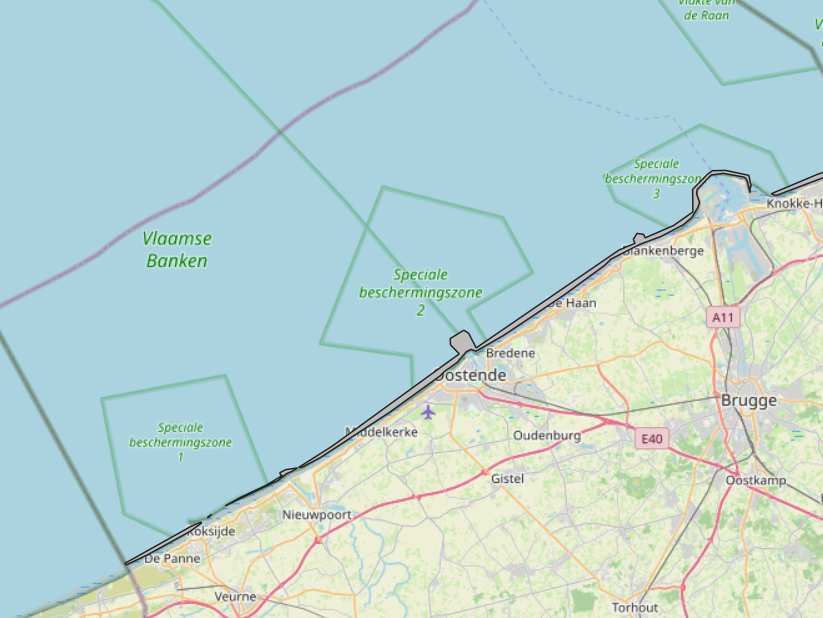
The Royal Decree of 20 March 2026 establishing the marine spatial plan for the period 2026 to 2034 in the Belgian marine areas defines 1 coastal protection experiments zone: Coastal protection belt (Art. 20§2). It replaces the 2020 Marine Spatial Plan. Please refer to the Belgian official gazette ("Moniteur belgeBelgisch Staatsblad") for official reference information.
-
This datasets is a compilation of all the campaigns tracks for the two RV Belgica (A962 and 11BU) from 1985 until today. It'll be regularly updated with new data.
-
UNDER EMBARGO - This dataset is part of BE/2023 sampling campagn in SW Greenland fjords (Igaliku and Tunulliarfik) and includes measurements of pelagic community respiration to assess microbial metabolic activity across fjords with contrasting glacial influence and seasonal conditions. Pelagic community respiration rates were determined following Martínez-García et al. (2009): seawater samples (200 mL; n = 4 replicates) were incubated with INT (final concentration 0.8 mM). Control samples were fixed with formaldehyde (2% final concentration) prior to incubation. After incubation, samples were filtered (0.2 μm), and the reduced INT (formazan) retained on filters was extracted with 1-propanol. Formazan concentration was determined spectrophotometrically at 485 nm, subtracting non-metabolic absorbance from controls. INT reduction rates were calculated as μmol INTf L⁻¹ h⁻¹ and subsequently converted to O₂ consumption rates (μmol O₂ L⁻¹ h⁻¹) following Martínez-García et al. (2019).
-
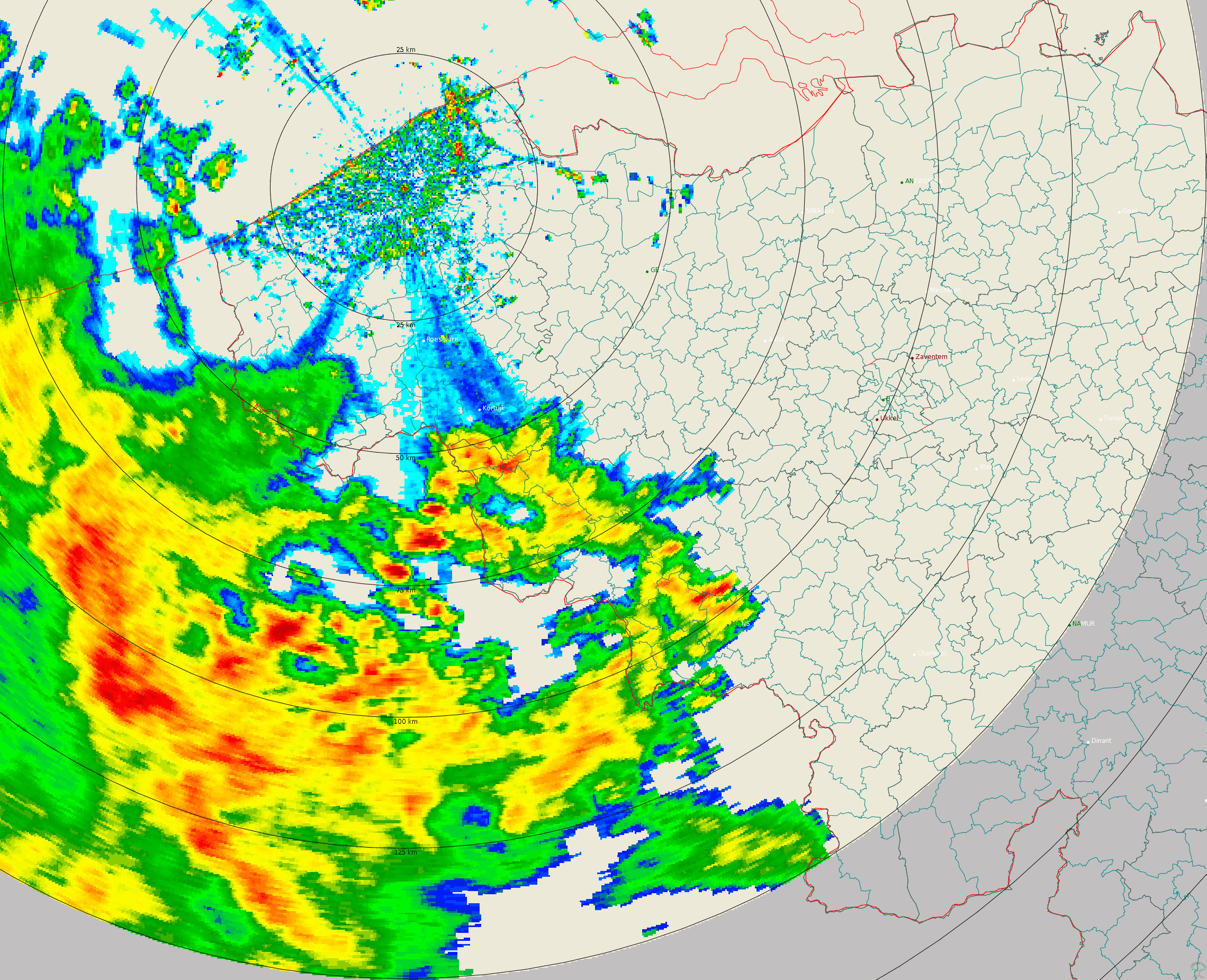
Polar volume reflectivity data from the Jabbeke weather radar. Volume data files are produced every 5 minutes from a multiple elevation scan.
-
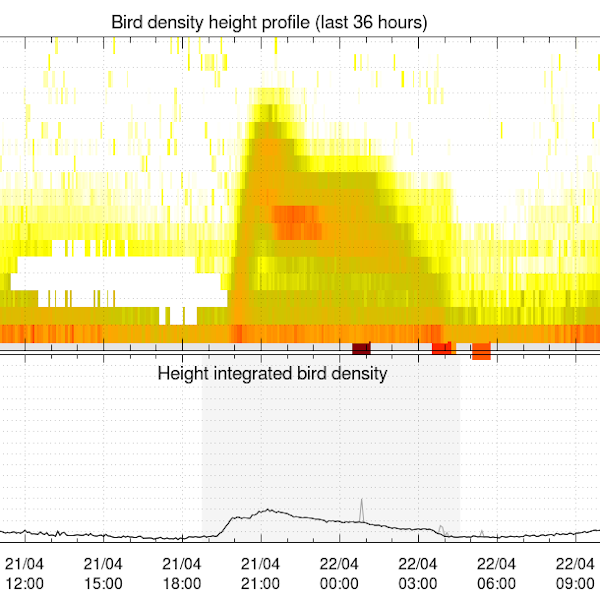
Bird density profiles are derived from weather radar volume data in real time, by the vol2bird algorithm as described in Dokter et al. (2011, 2019). The vol2bird algorithm exploits the radar reflectivity characteristics of different scatterers in the atmosphere, in order to distinguish biological from non-biological radar echoes. Once biological scatterers are isolated in the volume files, the reflectivity of these scatterers is converted in an estimate of the bird density per vertical layer of 200m, using a mean cross section of 11 cm2. The vbird profiles are provided for the following radars, with the radar owner in parentheses: Jabbeke (RMI), Wideumont (RMI), Helchteren (VMM), Zaventem (Skeyes), Herwijnen (KNMI), Den Helder (KNMI), Neuheilenbach (DWD), Essen (DWD), Abbeville (Météo-France) and Avesnois (Météo-France). References: - Dokter A.M., Liechti F., Stark H., Delobbe L., Tabary P., Holleman I., Bird migration flight altitudes studied by a network of operational weather radars, J. R. Soc. Interface, 8, 30–43, 2011, DOI 10.1098/rsif.2010.0116 - Dokter A.M., Desmet P., Spaaks J.H., van Hoey S., Veen L., Verlinden L., Nilsson C., Haase G., Leijnse H., Farnsworth A., Bouten W., Shamoun-Baranes J., bioRad: biological analysis and visualization of weather radar data, Ecography, 42, 852-860, 2019, DOI 10.1111/ecog.04028
-
UNDER EMBARGO - This dataset originates from the BE/2023 sampling campaign conducted in southwest Greenland fjords (Igaliku and Tunulliarfik) and quantifies grazing impacts by micro- and mesozooplankton on phytoplankton and heterotrophic microbial communities (including bacteria) in two fjord systems characterized by contrasting glacial regimes. Grazing and microbial growth rates were estimated using two-point dilution experiments (two-point dilution experiments), alongside experiments assessing mesozooplankton and copepod grazing on both phytoplankton and microzooplankton. Community responses were resolved using imaging flow cytometry, enabling the identification of plankton functional groups (autotrophic, mixotrophic, and heterotrophic) and size classes. The dataset also includes measurements of chlorophyll a variability determined by high-performance liquid chromatography. Overall, the dataset supports analyses of trophic interactions and grazing dynamics across the microbial food web under differing glacier-influenced environmental conditions.
-
UNDER EMBARGO - This dataset contains seasonal physiological measurements from controlled laboratory experiments on two dominant suspension-feeding species expected to colonise floating offshore structures: the blue mussel (Mytilus edulis; AphiaID 140480) and the wrinkled barnacle (Balanus crenatus; AphiaID 106215). The measured parameters include clearance rates, respiration rates, faecal pellet production rates, and faecal pellet sinking velocities. Mussels were collected from an aquaculture longline at the Westdiep SeaFarm, while barnacles were manually retrieved from the intertidal beachhead at Raversijde (Oostende, Belgium). All experiments were conducted using natural seawater collected from offshore sites in the Belgian part of the North Sea. Measurements were repeated across multiple seasons to capture temporal variability in physiological performance. The dataset was produced within the SWiM and EcoMPV projects and is suitable for reuse in ecosystem and biogeochemical modelling, including simulations of phytoplankton dynamics associated with large-scale offshore marine photovoltaic (MPV) developments.
-
The law of 13 June 1969 defines “Belgian Continental Shelf” as follows: the seabed and the subsoil of the marine areas adjacent to the Belgian coast but beyond the Belgian territorial sea.
-
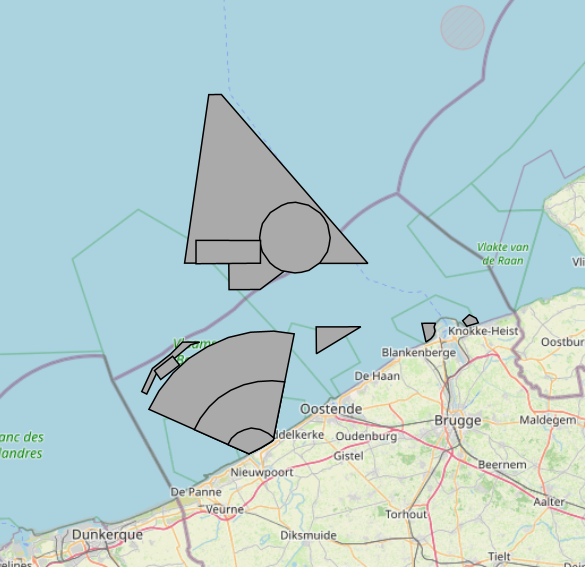
The Royal Decree of 20 March 2026 establishing the marine spatial plan for the period 2026 to 2034 in the Belgian marine areas defines 13 military use zones: Mine warfare exercise zone – QZR 040 (Art. 21§1.1°), Mine warfare exercise zone – NBH-10 (Wenduine) (Art. 21§1.2°), Mine warfare exercise zone – NB-01 (Westhinder) (Art. 21§1.3°), Mine warfare exercise zone (Buiten Ratel) (Art. 21§1.4°), Belgisch Nationaal Oefengebied voor Marineschepen (BNOM) (Art. 21§1.5°), Shallow Water Zone (Art. 21§1.6°), Zone for detonation exercises and operations (Art. 21§2), Lombardsijde firing sector: small sector (Art. 21§3.1°), Lombardsijde firing sector: middle sector (Art. 21§3.2°), Lombardsijde firing sector: large sector (Art. 21§3.3°), Paardenmarkt munitions disposal site (Art. 22§1). It replaces the 2020 Marine Spatial Plan. Please refer to the Belgian official gazette ("Moniteur belgeBelgisch Staatsblad") for official reference information.